


Vape Coil Resistance Explained: Most Beginners Get This Wrong (UK Guide)

By UK Vape Deals
Introduction
Vape coil resistance is measured in ohms and can have a major influence on your overall vaping experience. Move to lower resistance, and the vapour will be warmer with much bigger clouds, and battery life tends to drop. This vape coil resistance explained guide makes choosing the right setup easier.
It’s common for new vapers to blame the device, but often the Coil Vape resistance is the real issue. Pairing the wrong resistance with the wrong liquid or nicotine strength remains one of the top causes of burnt vape coils, harsh throat hits, and poor flavour for beginners. Some devices use replaceable coils, while others use refillable pods with integrated coils.
UK Vape Deals created this detailed guide to help you get more from your vape right from the start. Here you’ll learn what coil resistance really means, the mistakes beginners make, and how to choose the right coil for a vape based on your vaping style and liquid.
By the end, you’ll have vape ohms explained and avoid the most common pitfalls for UK vapers.
What Coil Vape Resistance Actually Means
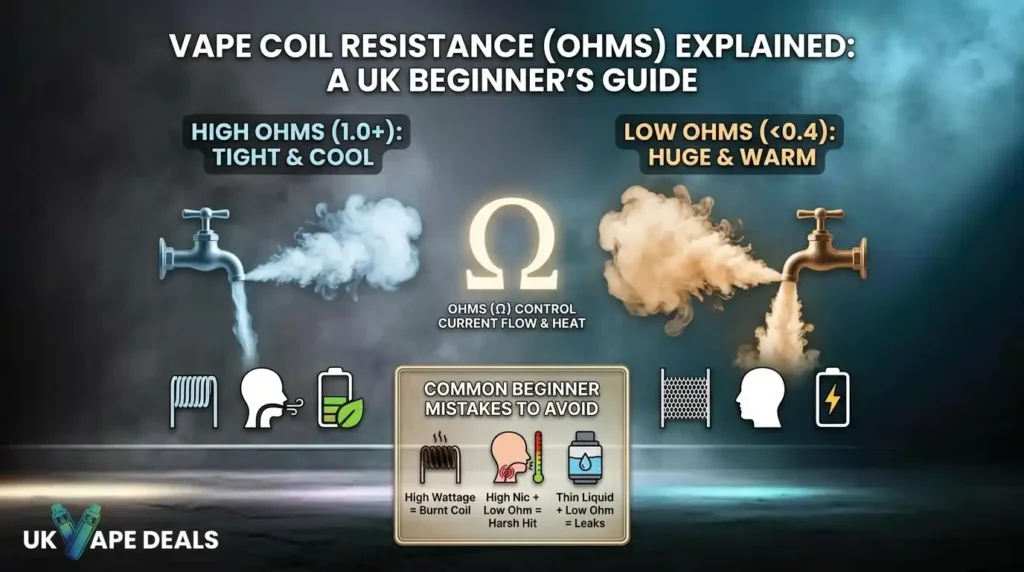
You don’t need to dive into electrical theory to understand what a Coil Vape is, how its resistance works, or why it matters. Vape coil resistance is measured in ohms and controls how much electrical current flows through the coil when you take a puff.
When your vape coils have lower resistance, more current rushes through them, creating intense and rapid heat. With a higher-resistance coil, much less current flows through it, so it heats more gently and takes a little longer to reach full temperature.
- A high-resistance coil is like turning the tap halfway off; only a little water (current) flows through.
- A low-resistance coil is like turning the tap fully open; lots of water (current) shoots through in a burst.
Here’s a direct summary to remember:
- Lower ohm number: more heat, more vapour, warmer draw, faster battery and liquid consumption.
- Higher ohm number: less heat, less vapour, cooler draw, slower battery and liquid use.
Mastering these basics will help you find the right balance between flavour, throat hit, and vapour, avoiding common mistakes many vapers make early on.
High Resistance vs Low Resistance Vape Coils Explained
Understanding vape coil resistance is key to choosing between high- and low-resistance coils for your vaping style. Always check compatibility before buying replacement pods or other replacement parts. Your entire experience changes depending on which you choose. Always check your Coil Vape ohm rating before buying replacement coils or starting a new device.
High resistance coils (1.0 ohm and above)
- You’ll get a tighter, more restricted draw (similar to smoking).
- Vapour production is low.
- Battery life lasts longer.
- Best with nic salts and 50/50 PG/VG e-liquids.
- Perfect for beginners, ex-smokers, and MTL (mouth-to-lung) vapers.
Medium resistance coils (0.6 – 0.8 ohm): Understanding the difference between 0.6 and 0.8 coil options
- Warm vapour with moderate cloud production.
- Draw is more open, less restrictive.
- Works well with 50/50 blends and medium VG e-liquids.
- Good for RDL (restricted direct lung) vapers or those moving from MTL toward more vapour.
Low resistance (sub-ohm) coils (below 0.4 ohm)
- Drains battery quickly, uses up a lot of e-liquid.
- Only compatible with thick (70% VG or higher) e-liquids.
- Not suitable for beginners or high nicotine strengths.
Coil Resistance Comparison Table
| Resistance | Vaping Style | Vapour Level | Best For |
|---|---|---|---|
| 1.0 ohm and above | MTL | Low | Beginners, nic salts, ex-smokers |
| 0.6 to 0.8 ohm | RDL | Moderate | Balanced vaping, flavor focus |
| Below 0.4 ohm | DTL | High | Cloud chasing, high VG liquids |
The Biggest Coil Vape Resistance Mistakes Beginners Make (And What Actually Happens)
Using high-nicotine nic salts in a sub-ohm coil:
Putting 20mg nic salts in a 0.2 or 0.3 ohm coil will result in a very rough, harsh throat hit and can make vaping almost unbearable. Sub-ohm coils are for low-nicotine freebase juice (typically 3-6mg).
Using thick, high VG liquid in a high-resistance pod:
Thick, 70% VG liquid just can’t wick properly into the tighter openings in high-resistance pod coils. Dry hits and burnt tastes result, even with a new coil. Pod kits are specifically designed for 50/50 or nic salt e-liquids.
Vaping above the recommended wattage:
All coils have a wattage range on the box or coil. Setting your device above the recommended level will fry your coil in minutes, and the burnt taste is permanent.
Chain vaping a new or primed coil:
Vaping rapidly, draw after draw, doesn’t give the coil enough time for the wick to resaturate. This causes dry hits and burns out the coil too soon.
Wrong Setup Table
| Wrong Setup | What Actually Happens |
|---|---|
| 20mg nic salts in a 0.2 ohm coil | Extremely harsh, unpleasant throat hit |
| 70% VG liquid in a high-resistance pod | Dry hits, burnt taste |
| Wattage set too high | Coil burns immediately |
| Chain vaping a new coil | Wick dries out and burns |
| Low ohm coil, no airflow adjustment | Hot, harsh, uncomfortable draw |
Best Vape Coil Resistance for Your Vaping Style: MTL, RDL and DTL Explained
Matching resistance to how you inhale is key to satisfaction. Here are the core styles:
MTL (Mouth to Lung): The closest experience to smoking.
- Best resistance: 0.8 – 1.2 ohms
- Low to moderate vapour output
- Best with 10mg–20mg nic salts and 50/50 e-liquids
RDL (Restricted Direct to Lung): More vapour, still some restriction.
- Best resistance: 0.6 – 0.8 ohms
- 3mg–10mg nicotine works well
- Good with 50/50 or “60/40” juices
DTL (Direct to Lung): Maximum vapour, fully open draw.
- Best resistance: 0.15 – 0.4 ohm
- Low nicotine (0–6mg), high VG juice
- Not for beginners, best for cloud chasing and flavour maxing
Knowing your style will help you choose the right Coil Vape and e-liquids.
Best Vape Coil Resistance for Beginners: Which Ohm Should You Choose?
Let’s break down the best resistance by what you want out of your first vape:
- Complete beginners:
0.8 – 1.2 ohms. Perfect for those who’ve never vaped before. - Ex-smokers:
1.0 – 1.2 ohms replicates the draw of a cigarette and works best with 10–20mg nic salts for a smooth throat hit. - Disposable vape users moving to refillables:
Stick with 1.0–1.2 ohm coils and nic salts, which feel familiar and give an easy transition. - More flavour seekers:
The difference between 0.6 and 0.8 coil options affects warmth, flavour and vapour without moving into huge cloud territory. - Cloud chasers:
Move toward 0.3–0.6 ohms, but only if you already understand wattage, liquid compatibility, and want big clouds.
Quick Recommendation Table
| You want | Best Resistance |
|---|---|
| Cigarette-like draw | 1.0 – 1.2 ohm |
| Smooth daily vaping | 0.8 ohm |
| Balanced flavor and vapor | 0.6 ohm – see the difference between 0.6 and 0.8 coil options |
| More vapour, moderate clouds | 0.4 – 0.6 ohm |
| Maximum cloud production | 0.15 – 0.3 ohm |
Matching Coil Resistance to Your E-Liquid
If you mix up your e-liquid and vape coil compatibility, you can quickly get dry hits, burnt coils, or leaking tanks.
- High resistance (1.0 ohm and above):
Only use 50/50 PG/VG or nic salt liquids. Thicker e-liquids can’t wick fast enough and will burn the coil. - Medium resistance (0.6–0.8 ohm):
Use 50/50 or medium VG up to about 60% VG. These can handle slightly thicker juices without flooding or burning. - Low resistance (sub-ohm, below 0.4 ohm):
Needs thick, high VG (70%+) e-liquids. If you use thin 50/50 in a sub-ohm, your tank may leak or spit.
Coil & Liquid Compatibility Table
| Coil Resistance | Best Liquid Type |
|---|---|
| 1.0 ohm and above | 50/50 blends, nic salts |
| 0.6 to 0.8 ohm | 50/50 or medium VG (up to 60%) |
| Below 0.4 ohm | High VG (70%+) |
Vape Coil Resistance and Wattage: How They Work Together
Vape coil resistance and wattage work together, so changing the resistance may require a different power setting. Some devices use a refillable pod with an integrated coil. When a vapour coil has lower resistance, more current rushes
- Above recommended wattage: The coil will burn almost immediately.
- Below recommended wattage: Weak flavour, little vapour.
Wattage Reference Table
| Resistance | Suggested Wattage Range |
|---|---|
| 1.2 ohm | 8–15W |
| 0.8 ohm | 12–20W |
| 0.6 ohm | 18–25W |
| 0.4 ohm | 25–40W |
| 0.2 ohm | 45–70W |
Mesh Coil vs Regular Coil: Which Is Better and Why It Matters
Regular wire coils use a strand (or two) of metal. They heat unevenly, with hot spots at contact points, which can mean occasional burnt hits. A refillable pod system is generally simpler for beginners. This vape coil resistance explained section covers how resistance affects vapour, flavour and power.
Mesh coils use a flat screen of perforated metal. The bigger surface area heats evenly, giving:
- More consistent flavor
- Fewer dry or burnt hits
- Longer coil life
0.6 Ohm vs 0.8 Ohm vs 1.2 Ohm: What Each One Actually Feels Like
The difference between 0.6 and 0.8 coil options is easier to understand when you look at warmth, vapour and draw style. Check compatibility before buying a replacement pod or coil. Here’s what you’ll really notice:
- 0.6 ohm coil: Vapour is warm, and you’ll see decent clouds. Flavours are clear and strong but suited to medium VG, low nicotine. Not the easiest starting place for new or ex-smokers.
- 0.8 ohm coil: The UK’s most popular for those moving from disposables. Restrictive but not tight, with warm (not hot) vapour and bold, smooth flavour. Handles most 50/50 liquids and up to 20mg nic salts readily. The battery lasts all day for most vapers.
- 1.2 ohm coil: Feels just like a cigarette. Draw is tight and restricted, with minimal, cool vapour. Delivers a gentle but satisfying throat hit, best for new vapers and ex-smokers using higher nicotine and nic salts, with the slowest battery drain.
Common Myths About Vape Coil Resistance
Our vape coil resistance explained guide helps beginners avoid common resistance mistakes. Clearing up myths stops you from making rookie mistakes:
- Myth: Sub-ohm vaping is just better
Sub-ohm setups are only “better” for certain goals (clouds, flavour chasing). For a high nicotine or a cigarette feel, higher resistance is superior for most. - Myth: Burnt taste means the device is faulty
It almost always means a burnt coil, not a device fault, usually from wattage, priming, or liquid mistakes. - Myth: Any liquid works in any coil
VG/PG ratios are crucial! Wrong liquid in the wrong coil causes dry hits or leaks regardless of price or quality.
Beginner Vape Setup Guide: Getting Resistance Right From Day One
Always follow the recommended coil range for your refillable pod device. Here’s a step-by-step for new UK vapers to nail resistance choice:
- Decide your preferred draw: Tight (like a cigarette) or open (direct lung/crowds)?
- Pick your nicotine strength: If you want or need high nicotine, stick to high resistance (0.8–1.2 ohm).
- Match the e-liquid: Pod kits and high resistance coils = 50/50 or nic salts. Low resistance = high VG only.
- Check the recommended wattage for your coil for a vape, then start at the lower end and increase gradually if needed.
- Prime your coil properly: Fill the tank, wait five minutes, and take gentle puffs without pressing the fire button if you can.
Follow this checklist for hassle-free set-up every time.
Honest Pros and Cons of Different Resistance Ranges for Beginners
High resistance (1.0 ohm and above)
Pros:
- Smooth hit
- Easy on the throat
- Cigarette feel
- Battery and e-liquid last longer
- Super beginner-friendly
- Wide choice of e-liquids
Cons:
- Barely any clouds
- Not satisfying for those wanting a wide-open draw
Medium resistance (0.6 – 0.8 ohm)
Pros:
- Tasty flavour
- Moderate vapour
- More liquid options
- Suits those stepping up from basic MTL
Cons:
- Not as smooth with higher nicotine
- Needs some liquid awareness
Low resistance (below 0.4 ohms)
Pros:
- Huge clouds
- Intense flavour (with the right juice)
- Best for “cloud chasing”
Cons:
- Not for beginners
- Burns through e-liquid and battery
- Harsh with high nicotine
- High VG required
Vape Coil Resistance: Frequently Asked Questions
What is vape coil resistance, and why does it matter?
Vape coil resistance refers to the amount of electrical resistance offered by a coil, measured in ohms (Ω). It affects how quickly the coil heats, the amount of vapour produced, flavour intensity, battery consumption, and the overall feel of each puff. Choosing the right resistance can make your vape smoother and more comfortable to use.
What coil resistance is best for beginners?
For most beginners, 0.8Ω to 1.2Ω coils offer a good balance of flavour, vapour production, and battery efficiency. These higher-resistance coils are commonly suited to mouth-to-lung vaping and provide a tighter draw that feels more familiar to people switching from smoking.
Can I use 20mg nicotine salts with a sub-ohm coil?
High-strength nicotine salts are generally not recommended with low-resistance sub-ohm coils. These coils produce more vapour and can deliver nicotine more quickly, which may result in an excessively strong or harsh experience. Higher-resistance pods are usually more appropriate for stronger nicotine salt e-liquids.
Is a lower ohm always better for vaping?
No. A lower resistance does not automatically mean a better vaping experience. For example, understanding the difference between 0.6Ω and 0.8Ω coils can help you choose the right option for your preferred vapour level, flavour, airflow, and battery consumption. Lower-resistance coils generally require more power, while higher-resistance coils are better suited to lower-wattage vaping.
How long do vape coils last?
Vape coils typically last around one to two weeks with regular use, although this varies between users. Frequent vaping, high wattage, chain vaping, and heavily sweetened e-liquids can cause coils to deteriorate faster. Check compatibility before buying a replacement pod or coil. A burnt taste, reduced flavour, weaker vapour, or unusual gurgling can indicate that the coil needs replacing.
What coil resistance feels closest to a cigarette?
For a cigarette-style vaping experience, 1.0Ω to 1.2Ω coils with restricted airflow are often a suitable choice. When paired with an appropriate nicotine salt e-liquid, these coils provide a tighter MTL draw with relatively modest vapour production. This setup can feel more familiar to adult smokers transitioning to vaping.
Categories


Explore More
Share this post

The UK Vape Market Evolution: Disposable Vape Ban and the Rise of Refillable Vapes
The UK vape market is evolving rapidly, influenced by changing regulations and growing concerns about public health and environmental sustainability.
Prefilled Pods vs Refillable Pods: Which Gives Better Value?
By UK Vape Deals When comparing refillable pods vs prefilled pods, the main differences are cost, convenience, flavour choice and
The Guide to Vaping Styles: Understanding the Different Ways Adults Vape in the UK
Vaping continues to evolve as one of the most common alternatives used by adults who want a method that differs

Is Vaping Still a Safer Alternative to Smoking? A Look at Health Perspectives
Quick Overview As the popularity of vaping has surged in recent years, many smokers have turned to vaping as an
 Titan X 50K Prefilled Pod Kit
 Hayati Pro Ultra Plus 25K Prefilled Pod Kit
 Al Fakher 30K Hypermax Vape Kit
 Relx Maxgo Combo 33K Prefilled Pod Kit
 RandM Fumot Tornado 18000 Puffs Vape Kit
 Firerose SlideGo 40K Prefilled Pod Kit
 Craving Bar Big Maxx 22k Prefilled Vape kit
 Hayati Pro Ultra Plus Shisha 30K Prefilled Pod Kit
 FEOBA Treo 33K Prefilled Pod Vape Kit
 Vapes Bars Angel 20K Prefilled Pod Kit